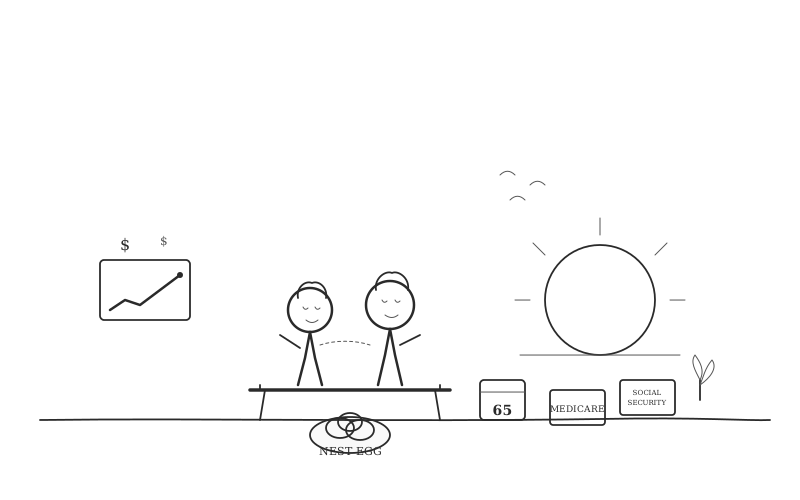
Two clocks run whether or not you are watching them. Medicare's initial enrolment period is seven months around your 65th birthday, and the Medigap window that follows it opens once and never reopens. Social Security is the opposite problem: nothing forces the decision, and claiming early locks in a permanent reduction. Handle the deadlines first, then the claiming decision, then the withdrawal order — in that sequence, because only the first one expires.
The dates and numbers that bind
- Full retirement age is 67 if you were born in 1960 or later. Claiming at 62 cuts the benefit by 30% permanently; waiting past full retirement age adds 8% a year until 70, and stops there (SSA; SSA; SSA).
- Medicare's initial enrolment period is seven months. It starts three months before the month you turn 65 and ends three months after it (Medicare).
- Part A is not automatic unless you are already drawing benefits. If you are not receiving Social Security or Railroad Retirement when you turn 65, nothing enrols you. You sign up yourself, and missing the window costs an extra 10% on Part B for each year you could have enrolled and did not — for most people, for life (Medicare).
- The Medigap window opens once. Six months, beginning the first day of the month you are both 65 and enrolled in Part B. Inside it an insurer cannot refuse you a policy it sells or charge you more for a pre-existing condition. Outside it, in most states, it can do both (Medicare).
- Part B costs $202.90 a month in 2026, with a $283 deductible. That is $17.90 a month more than 2025 (CMS, 2026).
- Income surcharges are set by your tax return from two years ago. Your 2026 premium comes from your 2024 return. Above $109,000 single or $218,000 joint, Part B rises to $284.10 and climbs to $689.90 at the top, with a Part D surcharge on top (CMS, 2026; SSA).
- Working before full retirement age withholds benefits. In 2026 you lose $1 for every $2 above $24,480, and $1 for every $3 above $65,160 in the year you reach full retirement age. From that month on, earnings stop reducing anything (SSA).
- Required distributions begin at 73. Miss one and the excise tax is 25%, reduced to 10% if corrected within two years (IRS).
The four windows that do not reopen
Most retirement decisions can be revisited. These four cannot, or can only be undone at a price, which is why they belong at the front of the list rather than wherever they happen to come up.
| Window | When | What missing it costs |
|---|---|---|
| Medicare initial enrolment | 7 months around your 65th birthday | 10% added to Part B for each year you could have enrolled, usually for life (Medicare) |
| Medigap open enrolment | 6 months from the first day of the month you are 65 and enrolled in Part B | Guaranteed issue ends. Insurers may decline you or price on health (Medicare) |
| Part D creditable coverage | Continuous; a gap of 63 days or more triggers it | 1% of the national base premium per uncovered month, added permanently (Medicare) |
| First required distribution | 1 April of the year after you turn 73 | 25% excise tax on the shortfall, 10% if corrected within two years (IRS) |
One trap inside the first row is worth naming, because it is the commonest route to a permanent Part B penalty. You can delay Part B without penalty while you are covered by an employer plan through active employment. COBRA and retiree coverage are neither. People treat them as employer coverage, delay, and find the penalty attached for life (Medicare).
The claiming decision
This is the one large, mostly irreversible financial decision that no deadline forces you to make, which is why it gets made badly. The mechanics are simple and worth stating precisely.
Full retirement age is 67 for anyone born in 1960 or later. Claim at 62 and the benefit is permanently 30% lower; the reduction is five-ninths of one percent a month for the first 36 months and five-twelfths of one percent for each month beyond that. Delay past full retirement age and it grows by two-thirds of one percent a month, 8% a year, until 70, where the credit stops (SSA; SSA; SSA). The 2026 cost-of-living adjustment was 2.8%, bringing the average retired worker's benefit to $2,071 a month and the maximum at full retirement age to $4,152 (SSA, 2026 fact sheet).
Three things are usually left out of the comparison, and each of them moves the answer.
Working while claiming early withholds benefits. Below full retirement age you lose $1 for every $2 earned above $24,480 in 2026. In the year you reach it, the test loosens to $1 for every $3 above $65,160, and from the month you reach it the test stops applying (SSA). The withheld months are not simply refunded: Social Security recalculates your reduction factor at full retirement age, which recovers the money slowly rather than at once.
A survivor inherits the larger record, with a floor. For a married couple, the higher earner's claiming age sets the survivor benefit for whoever lives longer. A surviving spouse at their own full retirement age receives 100% of what the deceased was receiving, 71.5% if claiming at 60, and children generally receive 75% (SSA). A spousal benefit while both are living tops out at 50% of the worker's primary insurance amount, and only if the spouse claiming has reached their own full retirement age (SSA).
Benefits are taxable above thresholds that have never been indexed. Up to 50% becomes taxable above $25,000 of provisional income single or $32,000 joint, and up to 85% above $34,000 or $44,000 (IRS Publication 915; SSA). Those four numbers have not moved since they were written, so inflation pulls more people over them every year (SSA). Plan around them rather than being surprised by them.
What comes out, and in what order
Three rules decide most of the tax on a retirement withdrawal, and two of them are commonly misstated.
The 10% additional tax on early distributions stops at 59 and a half, for qualified plans and IRAs alike (IRS). Before that, the rule of 55 lets you take distributions from a qualified plan without the additional tax if you separated from service in or after the year you turned 55 — but it applies only to the plan of the employer you left, and it does not cover IRAs at all (IRS Topic 558). Rolling that account into an IRA forfeits the exception, which is the detail that turns a good decision into a 10% bill.
Required distributions begin at 73 (IRS). A later start at 75 is written into statute for those born in 1960 or later, but it is not yet reflected on the IRS's own public pages, so treat it as law rather than as agency guidance until they catch up (SECURE 2.0, § 107).
From 70 and a half you can send up to $111,000 a year straight from an IRA to charity as a qualified charitable distribution, which satisfies a required distribution without appearing in your income at all (IRS; IRS Notice 2025-67). Note the gap: eligibility starts at 70 and a half, distributions are not required until 73.
If you are still working, the 2026 elective deferral limit is $24,500, with an $8,000 catch-up from age 50 and a larger $11,250 catch-up for anyone aged 60 to 63 (IRS Notice 2025-67). That third figure is new enough that plenty of people in its narrow age band never hear about it.
The six most expensive mistakes
| Mistake | Why it is expensive |
|---|---|
| Assuming Medicare enrols you | It does so only if you are already drawing benefits. Otherwise the seven-month window passes and the penalty attaches for life (Medicare; Medicare) |
| Treating COBRA as employer coverage | It is not, for Part B purposes. Delaying on the strength of it buys the same permanent penalty (Medicare) |
| Letting the Medigap window close | It opens once. After it, an insurer can decline you outright in most states (Medicare) |
| Converting to a Roth without checking the lookback | The income lands on the return that sets your Medicare premium two years later (SSA) |
| Rolling a 401(k) to an IRA before 59 and a half | It forfeits the rule-of-55 exception, which does not follow the money (IRS Topic 558) |
| Assuming an inherited Roth has no distributions | The owner's Roth has none in their lifetime; an inherited one is generally subject to the ten-year rule (IRS Publication 590-B) |
What Medicare does not pay for
Medicare does not cover long-term care. Its own words are that you pay all costs for non-covered services, including most long-term care (Medicare). This is the single largest gap between what people expect the programme to do and what it does, and it is worth confronting while you still have options, because insuring against it gets harder and dearer with every year you wait.
What your beneficiaries will face
Most non-spouse beneficiaries must empty an inherited IRA by 31 December of the year containing the tenth anniversary of the owner's death (IRS Publication 590-B). Eligible designated beneficiaries are exempt and may stretch distributions: a surviving spouse, a minor child of the owner, a disabled or chronically ill individual, and anyone not more than ten years younger than the owner (IRS Publication 590-B). Naming beneficiaries correctly is a half-hour job that decides a great deal, and it overrides your will.
Go deeper
Each of these takes one part of the page above and works it properly. Start with whichever decision is closest.
- the retirement decision engine — walks the claiming, Medicare and drawdown decisions against your own numbers.
- 2026 contribution limits — the deferral, catch-up and IRA figures, with the age 60 to 63 catch-up most people miss.
- Roth conversions — including the two-year Medicare lookback that decides when a conversion is affordable.
- the readiness estimator — projects a balance against a target and shows its assumptions.
- long-term care costs — the gap Medicare does not cover, and what planning for it involves.
- How much do I need to retire? — why there is no universal number, and how to estimate the gap your own spending leaves.
- Does the 4% rule still work? — the figure is Bengen 1994 rather than the Trinity Study, and he now puts his own worst case higher than four.
- The monthly spending analyzer — the spending figure every withdrawal rate depends on, which is the number most plans guess at.
Common questions
Can I retire at 55? It is possible, but two things decide it and neither is the size of your portfolio. The first is health coverage for the decade before Medicare. A marketplace plan is the usual route, and the arithmetic changed for 2026: the enhanced premium tax credits expired at the end of 2025 and the eligibility cliff at 400% of the federal poverty level is back, so a dollar of extra income above that line can cost you the entire subsidy (Congressional Research Service). The second is how you reach the money. The rule of 55 lets you take distributions from a qualified plan without the 10% additional tax if you separated from service in or after the year you turned 55 — but only from the plan of the employer you left, and not from an IRA at all (IRS Topic 558). Rolling that 401(k) into an IRA to tidy things up forfeits the exception, which is the single most expensive tidy-up in early retirement.
What if I have not saved enough? Working longer helps in three separate ways that are often run together. It adds contributions, it shortens the drawdown, and if you delay claiming past full retirement age it adds 8% a year to the benefit until 70 (SSA). That 8% is a delayed retirement credit for not claiming; it is not what an additional year of earnings adds to your record, which is usually far smaller and depends on whether the year replaces a lower one in your highest 35. Treat them as two separate levers, because only one of them requires you to keep working.
Should I pay off the mortgage before retiring? The comparison usually offered — a 3% mortgage against 7% investment returns, with the interest deducted — overstates the case twice. The 7% is a risky expected return set against a certain obligation, and the deduction assumes you itemise, which most retired households do not: the 2026 standard deduction is $32,200 for a married couple filing jointly, with an additional amount once you are 65 (IRS Rev. Proc. 2025-32). Run it with your own numbers and without the deduction unless you know you itemise. Then weigh what the arithmetic cannot capture, which is that a paid-off house lowers the income you must generate every year for the rest of your life.
How do I handle inflation in retirement? Social Security is adjusted annually; the 2026 increase was 2.8% (SSA). The trap specific to retirees is in the other direction. The income thresholds that make Social Security taxable — $25,000 and $34,000 single, $32,000 and $44,000 joint — have never been indexed, so every year inflation pulls more households above them without anyone deciding it should (SSA). Plan the withdrawal order around those four numbers rather than being surprised by them. A qualified charitable distribution from age 70 and a half is one of the few ways to satisfy a required distribution without the income appearing at all (IRS).
Sources
Every figure on this page is linked to the agency that publishes it. Where an agency does not publish a figure, this page says so rather than supplying one.
- Social Security: SSA full retirement age and reduction; SSA early claiming; SSA delayed retirement credits; SSA, 2026 fact sheet 2026 cost-of-living adjustment, average and maximum benefits; SSA the retirement earnings test; SSA spousal benefits; SSA survivor benefits; SSA taxation of benefits; SSA why the thresholds do not move.
- Medicare: CMS, 2026 2026 Part B premium, deductible and income-related surcharges; SSA the two-year lookback; Medicare the initial enrolment period; Medicare late-enrolment penalties; Medicare Medigap open enrolment; Medicare long-term care.
- IRS: IRS required minimum distributions; IRS Notice 2025-67 2026 contribution and catch-up limits and the qualified charitable distribution limit; IRS Topic 558 the rule of 55; IRS age 59 and a half; IRS qualified charitable distributions; IRS Publication 915 taxation of Social Security; IRS Publication 590-B inherited accounts and the ten-year rule.
- Statute: SECURE 2.0, § 107 the later required-distribution age, which the IRS has not yet reflected in its public guidance.