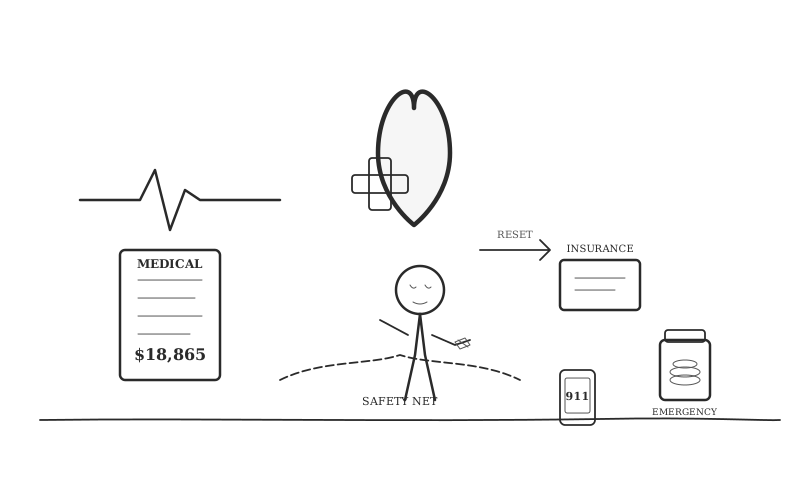
1. The Medical Debt Crisis in 2026
Medical debt is the #1 source of debt collections in America. The Kaiser Family Foundation (KFF) reports that approximately 100 million Americans — 41% of adults — carry some form of medical debt. The Consumer Financial Protection Bureau found that medical debt in collections totals approximately $88 billion. And a landmark study in the American Journal of Public Health found that 66.5% of all bankruptcies are connected to medical bills or illness — either the bills themselves or the income loss from being too sick to work.
Want to see how this fits YOUR situation? Try the Medical Event Decision Support Engine →
The costs that create this crisis: the average emergency room visit costs $2,200 (American College of Emergency Physicians). The average 3-day hospital stay costs $30,000-$35,000. An appendectomy costs $33,000. A hip replacement costs $40,000-$65,000. Childbirth costs $18,865 on average (Peterson-KFF). Cancer treatment averages $150,000+ over the course of illness. And these are the insured costs — uninsured patients face charges 2-4x higher.
But the medical debt crisis is not inevitable. Most medical bills are negotiable, most hospitals are legally required to offer financial assistance, and the credit reporting rules now provide a 12-month buffer before medical debt affects your credit. The difference between a medical emergency that destroys your finances and one that you survive financially is knowledge — knowing your rights, your options, and the specific steps to take. This guide provides that knowledge.
2. The First 48 Hours: Financial Triage
During a medical emergency, your only priority is health and safety. Financial management begins within 48 hours — when the immediate medical crisis has stabilized and you can begin processing the financial implications.
Hour 1-24 (during or immediately after the medical event): If conscious and able, provide your insurance information to the hospital. Confirm that the facility is in your insurance network (the No Surprises Act protects you for emergency services regardless of network status, but knowing your coverage helps). If uninsured, ask to speak with a financial counselor or social worker at the hospital — they can begin the financial assistance application process immediately. Do not sign any financial responsibility documents without reading them (though in emergencies, you may not have this option — EMTALA requires hospitals to treat emergency patients regardless of ability to pay).
Hour 24-48: Contact your health insurance company to report the medical event and understand your coverage. Ask specifically: what is your remaining deductible for the year? What is your out-of-pocket maximum? Is the facility in-network? Are any services likely to require pre-authorization? If the emergency caused you to miss work, notify your employer about FMLA leave (12 weeks of unpaid, job-protected leave) and any short-term disability insurance you have. If someone else caused the injury (car accident, workplace injury, assault), contact a personal injury attorney — their services are typically contingency-based (no upfront cost) and the responsible party's insurance may cover your medical costs.
What NOT to do in the first 48 hours: Do not put medical bills on a credit card (you lose all negotiating leverage and the debt transfers from 0% medical debt to 18-25% credit card debt). Do not agree to any payment arrangements before receiving and reviewing an itemized bill. Do not withdraw from retirement accounts. Do not ignore bills — but don't panic about them either. You have time. Medical bills have long timelines: 30-90 days before the first bill arrives, 12 months before they can appear on your credit report, and typically 3-7 years before the statute of limitations on medical debt expires. Use this time strategically.
3. Understanding Your Hospital Bill
Hospital bills are notoriously complex and opaque. A single hospital stay generates bills from multiple providers: the hospital facility (room, nursing, supplies, medications), the treating physician(s), the anesthesiologist (if applicable), the radiologist (for imaging), the pathologist (for lab work), the emergency physician (separate from the treating physician), and any specialists consulted. Each provider bills separately, and each may be in or out of your insurance network independently. It is common to receive 5-8 separate bills from a single hospital stay.
The chargemaster problem: Hospitals set their own list prices (the "chargemaster"), which bear little relation to actual costs or what insurers actually pay. A hospital may list an aspirin at $25, a bag of IV saline at $300, or a CT scan at $4,000 — prices that are 5-20x what Medicare pays for the same items. If you're uninsured, you may be billed at chargemaster rates, which are the highest prices in the system. This is why requesting the itemized bill and comparing against fair market prices is essential — you should never pay chargemaster rates without negotiation.
Your right to an itemized bill: Request an itemized bill from every provider. This is your legal right. The itemized bill lists every charge individually — every medication, every supply, every procedure, every test. Without the itemized bill, you're looking at summary charges like "Room and Board: $15,000" with no way to verify accuracy. The itemized bill is where you find the billing errors that affect 30-80% of hospital bills.
Understanding the Explanation of Benefits (EOB): Your insurance company sends an EOB for every claim processed — this is NOT a bill. The EOB shows: the total billed amount (what the provider charged), the allowed amount (what your insurance considers the fair price — often 40-70% less than the billed amount), the insurance payment (what your insurer actually paid the provider), and your responsibility (your deductible, copay, and coinsurance). Compare the EOB to the provider's bill to ensure your responsibility matches. If the provider is billing you for more than the EOB states, they're overcharging — contact them with the EOB as evidence. Many patients pay the provider's bill without checking the EOB, overpaying by hundreds or thousands of dollars.
The price transparency mandate: Since January 2021, hospitals are required to publish their prices online in machine-readable format, including negotiated rates with every insurer. Since January 2023, the Transparency in Coverage Rule requires insurers to publish their negotiated rates as well. You can use tools like Turquoise Health (turquoise.health), Healthcare Bluebook, and CMS's Hospital Price Transparency data to see what hospitals charge for specific services and what insurers actually pay. This data is your leverage in negotiation — if Medicare pays $3,200 for an appendectomy and the hospital charged you $33,000, you have a data-backed argument for a significant reduction.
4. Finding and Disputing Billing Errors
Studies estimate that 30-80% of hospital bills contain errors — ranging from duplicate charges to billing for services never provided. Common errors include: duplicate charges (the same test or medication billed twice), upcoding (billing for a more expensive procedure than what was performed — e.g., charging for a complex ER visit when you had a straightforward one), unbundling (separately billing for components of a procedure that should be billed as a package), incorrect quantities (10 pills billed when 5 were administered), charges for services not received (a specialist consultation that never happened), and incorrect patient information (another patient's charges on your bill).
How to audit your bill: Request the itemized bill from every provider. Compare each line item against your medical records (request these from the hospital — it's your right under HIPAA). Use Healthcare Bluebook (healthcarebluebook.com) or the CMS price transparency tool to compare charges against fair market prices in your area. Flag any charge that appears duplicated, that you don't recognize, or that is significantly above fair market price. Contact the billing department with specific disputed items — be polite but firm, reference the specific charges by line item, and ask for correction. If the provider won't correct errors, escalate to your state's Department of Insurance or the hospital's patient advocate.
5. Insurance Claims, Denials, and Appeals
Your insurance company may deny coverage for specific services or an entire claim. Approximately 15-20% of initial claims are denied. But here's the critical fact: the majority of denied claims that are appealed are overturned. According to KFF analysis, 39-59% of external appeals result in decisions favorable to the patient. Yet fewer than 1% of denials are actually appealed — meaning millions of patients pay bills that their insurance should have covered.
The appeals process: Internal appeal (Level 1): submit a written appeal to your insurer within 180 days of the denial, including your medical records, a letter from your treating physician explaining why the service was medically necessary, and any supporting clinical evidence. The insurer must respond within 30 days (72 hours for urgent care). External appeal (Level 2): if the internal appeal is denied, you have the right to an external review by an independent third party. This is free, and the external reviewer's decision is binding on the insurer. Your state Department of Insurance can guide you through the process. For employer-sponsored plans, you can also file a complaint with the Department of Labor's Employee Benefits Security Administration.
Common denial reasons and how to counter them: "Not medically necessary" — obtain a letter of medical necessity from your treating physician detailing why the service was essential. Include peer-reviewed medical literature supporting the treatment. Many denials are overturned when clinical evidence is presented because the initial denial was made by a claims processor, not a physician. "Out of network" — if the service was an emergency, invoke the No Surprises Act (Section 6). If a non-emergency service at an in-network facility was provided by an out-of-network provider you didn't choose, the No Surprises Act also applies. "Pre-authorization not obtained" — if the emergency nature of the situation prevented pre-authorization, document this in your appeal. Many states have laws requiring insurers to cover emergency services regardless of pre-authorization. "Experimental or investigational" — provide clinical trial data, FDA approvals, or medical society guidelines supporting the treatment as standard of care.
The appeal timeline and your rights: You have 180 days from the denial date to file an internal appeal. The insurer must respond within 30 days for non-urgent claims and 72 hours for urgent/active treatment. If the internal appeal is denied, you have 4 months to request an external review. During the appeal process, the insurer cannot send the bill to collections or require you to pay the disputed amount. This is a critical protection — you can dispute a $50,000 charge for months without any collection activity or credit impact while the appeal is processed. If you're currently receiving treatment that was denied, you can request an expedited appeal (72-hour turnaround) to prevent interruption of care.
Free help with appeals: You don't have to navigate the appeals process alone. Your state's Department of Insurance has a consumer assistance program that helps with appeals — free of charge. The Patient Advocate Foundation (patientadvocate.org) provides free case management for patients struggling with insurance denials. Many hospitals have patient advocates or social workers who can help you file appeals and navigate the system. If your claim exceeds $10,000 and involves a complex denial, hiring a medical billing advocate ($100-$200/hour or 25-35% of savings) may be worthwhile — they know the system intimately and achieve higher success rates than self-filed appeals.
6. The No Surprises Act: Your Protection
The No Surprises Act (effective January 2022) is the most significant patient financial protection law in a decade. It prohibits surprise out-of-network bills in three situations: emergency services at any facility (your cost-sharing is limited to in-network rates regardless of the facility's network status), non-emergency services at in-network facilities by out-of-network providers you didn't choose (the anesthesiologist, radiologist, or specialist who was out-of-network but was assigned to your case), and air ambulance services by out-of-network providers. Under the Act, providers cannot "balance bill" you for the difference between the out-of-network charge and your insurer's payment. Disputes between the provider and insurer go to an Independent Dispute Resolution (IDR) process — you are not involved in this dispute. If you receive a surprise bill that violates the No Surprises Act, report it to CMS at cms.gov/nosurprises and to your state Department of Insurance.
7. Negotiating Medical Bills: The 30-60% Reduction
Medical bills are negotiable — and the discounts available are substantial. Research from JAMA Internal Medicine found that 50-65% of patients who negotiate their medical bills receive reductions. The average negotiated discount is 25-50% of the original bill. On a $30,000 hospital stay, a 40% reduction saves $12,000.
The negotiation playbook: Step 1: Request the itemized bill and audit for errors (Section 4). Step 2: Research fair prices for your procedures using Healthcare Bluebook, CMS price transparency data, or Medicare payment rates (Medicare pays roughly 80% of the cost for most services — ask the hospital what Medicare would pay for the same services, then offer 120-150% of Medicare rates). Step 3: Call the billing department and say: "I'd like to discuss my bill. I've reviewed the charges and compared them against fair market prices. I'd like to negotiate a fair price." Step 4: Ask specifically about the self-pay discount (most hospitals offer 20-40% off for patients paying without insurance), the prompt-pay discount (an additional 10-20% for paying the full negotiated amount within 30 days), and the financial hardship discount (income-based reductions of 25-100%). Step 5: If the phone representative can't offer a sufficient discount, ask to speak with a supervisor or the hospital's financial counselor. See our Medical Debt Negotiation Guide for the complete script and strategy.
The exact script that works: "Hello, I'm calling about my account [number]. I received an itemized bill for [amount] and I've compared the charges against Medicare rates and Healthcare Bluebook fair prices. Several charges appear significantly above fair market value. I'd like to negotiate a fair price that I can pay. Can you help me with that?" If they offer 10-15%, say: "I appreciate that, but I've seen that most hospitals offer self-pay discounts of 30-40%. I'd like to pay a fair price closer to what insurance companies actually pay for these services. Can you match the Medicare rate plus 25%?" If they resist, say: "I understand. Could you connect me with a financial counselor or supervisor who might have more flexibility? I want to pay what I owe, but I need the amount to reflect fair market pricing." Be polite, persistent, and prepared — having the Medicare rate data and fair market comparisons ready demonstrates that you've done your homework and aren't simply asking for a handout.
If the bill goes to collections: If a medical bill reaches a collection agency, you still have options. First, verify the debt — under the Fair Debt Collection Practices Act (FDCPA), you can request written verification of the debt within 30 days of first contact. The collector must provide the original creditor, the amount, and documentation supporting the debt. Second, check the statute of limitations in your state — if the debt is past the statute (3-7 years depending on state), the collector cannot sue you to collect. Third, negotiate a settlement: collection agencies purchase medical debt for 4-7 cents on the dollar, meaning they can accept 20-50% of the original amount and still profit. Offer 25-30% as a starting point. Fourth, request a pay-for-delete agreement — the collector removes the account from your credit report in exchange for payment. Get any agreement in writing before paying. And remember: under the 2023 credit reporting rules, paid medical collections are removed from credit reports entirely, and medical debt under $500 is excluded — so paying a medical collection now results in its removal from your report.
8. Hospital Financial Assistance (Charity Care)
Nonprofit hospitals — which constitute approximately 57% of all US hospitals — are legally required under Section 501(r) of the Internal Revenue Code to maintain financial assistance policies (FAP), also known as charity care programs. These programs provide free or discounted care to patients who meet income thresholds, which vary by hospital but typically cover patients with incomes up to 200-400% of the Federal Poverty Level ($31,200-$62,400 for an individual in 2026). Some hospitals extend assistance to higher incomes based on the balance relative to income.
To apply: request the hospital's financial assistance application from the billing department or download it from the hospital's website (they're required to make it available). Complete the application with income documentation (recent pay stubs, tax return, bank statements). Submit and wait — most hospitals process applications within 30-60 days. While the application is pending, your bill should not go to collections. If approved, your bill may be reduced by 50-100% — many patients with incomes below 200% FPL receive 100% forgiveness (free care). This is not a loan, not a payment plan — it is a reduction of the bill itself. Fewer than half of eligible patients apply for financial assistance because they don't know it exists. You may be leaving thousands — or tens of thousands — of dollars on the table.
How to find out if your hospital qualifies: All nonprofit hospitals (tax-exempt under Section 501(c)(3)) must offer financial assistance — this is a federal legal requirement. Approximately 57% of US hospitals are nonprofit. Check your hospital's tax status: the IRS maintains a database of tax-exempt organizations (apps.irs.gov/app/eos), or simply ask the billing department "Are you a 501(c)(3) nonprofit hospital?" If yes, they must have a financial assistance policy. Even for-profit hospitals often have charity care programs or financial hardship policies — they're not legally required to, but many do because bad debt is more expensive than discounted care. Always ask. The worst they can say is no.
State-level protections beyond federal requirements: Many states have additional hospital billing protections that go beyond federal law. California's Hospital Fair Pricing Act limits bills for uninsured patients at or below 400% FPL to the amount that would have been paid by Medicare or Medi-Cal — effectively capping uninsured bills at government rates. New York limits bills for uninsured patients to the amount negotiated with the state's largest insurer. Colorado caps out-of-pocket costs for insured patients at in-network rates for emergency services. Illinois, Maryland, New Jersey, and Washington have similar protections. Check your state's hospital billing laws through your state Attorney General's website or your state Department of Health — you may have protections you don't know about.
Nonprofit organizations that help pay medical bills: Beyond hospital financial assistance, numerous nonprofits help patients with specific conditions pay for treatment. The Patient Advocate Foundation (case management and financial assistance). HealthWell Foundation (copay assistance for specific medications). PAN Foundation (premium and copay assistance). NeedyMeds (database of patient assistance programs). Disease-specific organizations (American Cancer Society, Leukemia & Lymphoma Society, National MS Society, American Heart Association) often have financial assistance programs for treatment costs, transportation, lodging, and living expenses during treatment. United Way's 211 helpline connects you to local resources. Many of these programs go underutilized because patients don't know they exist — and healthcare providers don't always tell you about them.
9. Payment Plans and Medical Credit Cards
If you can't pay the full negotiated balance, most hospitals offer 0% interest payment plans of $25-$200/month. These plans are almost always available — hospitals prefer steady payments to bad debt write-offs. A $10,000 bill at $100/month takes 100 months (8+ years) to pay off — but at 0% interest, the total cost is exactly $10,000. This is dramatically cheaper than credit card debt at 18-25% interest, where the same $10,000 costs $15,000-$20,000 over the same period.
Avoid medical credit cards (CareCredit, etc.): Medical credit cards offer a "promotional 0% interest period" (typically 6-24 months), after which the interest rate jumps to 26-29%. If you fail to pay the full balance before the promotional period ends, interest is charged retroactively on the entire original balance — turning a $5,000 balance into $6,500-$7,000 overnight. The hospital's own 0% payment plan is almost always a better option. If you must use a medical credit card, set up payments that guarantee full payoff before the promotional period ends — and set calendar reminders 60 days before expiration.
10. Protecting Your Credit from Medical Debt
The credit reporting rules for medical debt changed significantly in 2023, providing important new protections. Paid medical collections are removed from credit reports entirely. Unpaid medical debts under $500 are excluded from credit reports. Medical debt must be at least one year old before it can appear on credit reports. This 12-month window is your strategic advantage — you have a full year to negotiate, apply for financial assistance, set up payment plans, or otherwise resolve the debt before any credit impact occurs.
However, if you put medical expenses on credit cards, the resulting credit card debt does not receive these protections. Credit card balances affect your credit score immediately through utilization ratios, and late credit card payments are reported after just 30 days. This is why the #1 rule of medical debt management is: never put medical bills on credit cards. See our Credit Score Protection Playbook for comprehensive credit strategies during a medical crisis.
11. Managing Income Loss During Recovery
A medical emergency often involves not just the bills but also lost income during recovery. The financial triage for income loss during medical recovery: short-term disability insurance (if your employer offers it, file a claim immediately — covers 50-70% of salary for 3-6 months), FMLA leave (12 weeks of unpaid but job-protected leave — your employer cannot fire you during FMLA), state paid family/medical leave (13 states + DC — 4-12 weeks at 55-90% of wages), workers' compensation (if the injury was work-related — covers medical bills AND lost wages at 66% of average weekly wage), and Social Security Disability Insurance (SSDI — for long-term disabilities expected to last 12+ months). See our Job Loss Financial Reset for detailed income replacement strategies and the debt triage priority order.
Short-term disability deep dive: If your employer offers STD insurance, you were likely enrolled automatically or during open enrollment. STD typically covers 50-70% of your base salary for 3-6 months after an elimination period (usually 7-14 days for illness, 0 days for accidents). File the claim within 30 days of the disabling event — late filings can be denied. Your physician must certify that you're unable to perform your job duties. STD benefits are taxable if your employer paid the premiums; tax-free if you paid the premiums yourself. If STD expires and you're still unable to work, long-term disability (LTD) coverage picks up — typically at 60% of salary for up to age 65 or Social Security Normal Retirement Age.
The FMLA protection: FMLA provides 12 weeks of unpaid, job-protected leave per year for a serious health condition affecting you or an immediate family member. Eligibility requires: you've worked for the employer for at least 12 months, you've worked at least 1,250 hours in the last 12 months, and the employer has 50+ employees within 75 miles. During FMLA, your employer must maintain your health insurance on the same terms as if you were working. When you return, you must be restored to the same or an equivalent position. FMLA is unpaid — but you can use accrued PTO, sick leave, and vacation time concurrently (and your employer may require it). File FMLA paperwork as soon as you know you'll need extended leave — waiting until you've exhausted your PTO leaves you unprotected.
Workers' compensation: If the medical emergency resulted from a work-related injury or illness, workers' compensation covers all medical expenses (no deductible, no copay, no limit) plus wage replacement at approximately 66% of your average weekly wage. Report workplace injuries to your employer immediately — most states have strict deadlines (30-90 days from injury). Workers' comp claims do not go through your health insurance and do not affect your health insurance premiums or claims history. If your workers' comp claim is denied, you have the right to appeal — consult a workers' compensation attorney (typically contingency-based, meaning no upfront cost).
12. Government Programs and Safety Nets
Several government programs provide financial assistance during medical emergencies. Medicaid retroactive coverage: Medicaid can cover medical bills for up to 3 months before the application date in most states. If a medical emergency pushed your income below Medicaid thresholds (138% FPL in expansion states — $20,783 for an individual), apply immediately and request retroactive coverage. Hospital Presumptive Eligibility: many hospitals can enroll you in Medicaid on the spot during an emergency, with coverage effective immediately. SNAP and utility assistance: if income loss from the medical event reduces your household income, apply for food assistance (SNAP) and energy assistance (LIHEAP) through your local 211 helpline. State Catastrophic Illness Programs: several states have programs that provide financial assistance for catastrophic medical costs — contact your state's Department of Health for available programs.
The Medicaid retroactive coverage strategy: This is one of the most powerful and underused protections for uninsured patients. If you had no insurance (or insufficient insurance) at the time of the medical emergency, and your current income qualifies for Medicaid, you can apply after the medical event and request coverage retroactive to 3 months before the application date. If the medical emergency occurred within that 3-month window, Medicaid covers the bills — even though you weren't enrolled at the time of service. In expansion states (39 states + DC as of 2026), individuals with income up to 138% FPL ($20,783 individual / $28,208 couple) qualify. In non-expansion states, qualification is more restrictive but pregnant women, children, and disabled individuals have higher income thresholds. Apply immediately after the emergency, even if you're not sure you qualify — the worst outcome is denial, and the best outcome is tens of thousands of dollars in bills covered.
Medicare for medical emergencies (if age 65+): If you're on Medicare, your out-of-pocket costs for a medical emergency are capped by your plan's structure. Original Medicare (Parts A + B) has a Part A deductible of $1,676 per benefit period for hospital stays (2026), then $0 copay for days 1-60. Part B covers 80% of outpatient costs after the $257 annual deductible. A Medigap supplement (Plans F or G) covers most or all remaining out-of-pocket costs. Medicare Advantage plans have annual out-of-pocket maximums of $3,450-$8,850. If you're on Original Medicare without a Medigap supplement, a major medical event can still generate $5,000-$15,000 in out-of-pocket costs — a strong argument for carrying a Medigap supplement if your budget allows.
The medical expense tax deduction: Medical expenses that exceed 7.5% of your Adjusted Gross Income (AGI) are deductible if you itemize. For a household with $60,000 AGI and $15,000 in medical expenses, $10,500 ($15,000 - $4,500 threshold) is deductible — saving approximately $2,310 in federal taxes at the 22% bracket. Qualifying expenses include hospital and doctor bills, prescription medications, health insurance premiums (if not paid pre-tax), medical devices, transportation to medical appointments (mileage at $0.67/mile or actual costs), long-term care costs, and home modifications for medical reasons. Keep meticulous records of all medical expenses — receipts, EOBs, pharmacy records, mileage logs — and consult a tax professional in the year of a major medical event to ensure you capture all available deductions.
13. The Financial Recovery Timeline
Week 1-2: Focus on health. File FMLA and disability claims. Notify creditors if you'll miss payments — request hardship programs. If uninsured, ask the hospital social worker about Medicaid presumptive eligibility and financial assistance applications immediately. Do not engage with any bills yet — wait for itemized statements and insurance EOBs.
Month 1-3: Request all itemized bills. Audit for errors (Section 4). Compare charges against fair market prices using Healthcare Bluebook and CMS transparency data. File insurance claims and appeals for any denials — remember, 39-59% of appeals succeed. Apply for hospital financial assistance at every nonprofit facility that treated you. Research government programs (Medicaid retroactive, state catastrophic illness programs). If you had an accident caused by someone else, consult a personal injury attorney (free consultation, contingency-based representation). Begin organizing all medical documents (bills, EOBs, correspondence, payment records) in a dedicated folder — you'll need these for tax deductions, ongoing negotiations, and potential appeals.
Month 3-6: Negotiate remaining balances using the playbook in Section 7. Set up 0% payment plans for any amounts you can't pay in full. Apply for assistance from nonprofit organizations (Patient Advocate Foundation, disease-specific charities, NeedyMeds). If income loss is ongoing, apply for SSDI (Social Security Disability Insurance) — the application process takes 3-6 months, so early filing is essential. Begin rebuilding emergency fund once income stabilizes — even $50-$100/month begins restoring the financial cushion.
Month 6-12: Monitor credit reports for any medical debt appearing (shouldn't appear until month 12+ under new rules). Continue payment plans. File year-end taxes with medical expense deductions (expenses exceeding 7.5% of AGI are deductible if you itemize). Assess whether HSA contributions should increase to build a medical reserve. Review health insurance during open enrollment — your medical event may have changed which plan is optimal (a plan with lower deductible and higher premium may now be more cost-effective if ongoing care is needed). Request updated cost estimates for any ongoing treatment.
Year 2 and beyond: Continue payment plans until balances are resolved. If a balance is approaching the statute of limitations (3-7 years depending on state) and you've been making regular payments, evaluate whether continuing to pay is worthwhile versus letting the statute expire — consult a consumer debt attorney for guidance specific to your state. Review your emergency fund target — after a medical emergency, many financial planners recommend increasing the target from 6 months to 9-12 months of expenses, given the demonstrated vulnerability to health-related financial shocks. Consider supplemental insurance products: critical illness insurance (pays a lump sum of $10,000-$100,000 upon diagnosis of covered conditions like cancer, heart attack, or stroke), hospital indemnity insurance (pays a fixed daily amount during hospitalization), and accident insurance (pays for specific injuries and treatments). These products don't replace health insurance but provide cash flow during medical events that health insurance copays and deductibles don't cover.
Preparing for the next medical emergency: The most effective financial protection against a future medical emergency is preparation that happens before the crisis. Build and maintain a 6-month emergency fund (minimum). Maximize your HSA if you're on an HDHP — HSA funds are the most tax-efficient way to pay medical bills ($8,750 family contribution limit in 2026, growing tax-free, withdrawn tax-free for medical expenses). Understand your health insurance plan — know your deductible, out-of-pocket maximum, network, and pre-authorization requirements before you need them. Keep a medical financial folder with your insurance cards, plan documents, emergency contacts, and a list of your medications. Create a medical power of attorney and advance healthcare directive so that if you're incapacitated, someone you trust can manage both your medical care and your finances. Review your health insurance annually during open enrollment — the plan that was optimal last year may not be optimal this year if your health needs have changed.
The HSA as your medical emergency fund: The Health Savings Account is uniquely suited as a medical emergency fund because of its triple tax advantage: contributions are pre-tax (reducing current income tax), growth is tax-free (invested funds grow without taxation), and withdrawals for medical expenses are tax-free (no tax at any point in the lifecycle). A family contributing $8,750/year to an HSA for 10 years at 7% return accumulates approximately $121,000 — enough to cover the out-of-pocket maximum for multiple years of medical emergencies, a significant hospitalization, or a substantial portion of the $330,000 lifetime healthcare cost estimate. Unlike a Flexible Spending Account (FSA), HSA funds roll over indefinitely — there is no "use it or lose it" provision. And after age 65, HSA withdrawals for any purpose (not just medical) are penalty-free, making the HSA a supplemental retirement account. The HSA is the single most underutilized financial tool in America — and a medical emergency is the event that demonstrates its value most clearly. See our HSA Strategy Guide for the complete investment and optimization playbook.
14. The 10 Costliest Medical Emergency Financial Mistakes
1. Putting medical bills on credit cards. Converts 0% medical debt to 18-25% credit card debt and eliminates negotiating leverage. 2. Not requesting an itemized bill. You can't find errors in a summary. 30-80% of bills contain errors. 3. Not negotiating. 50-65% of patients who negotiate get reductions of 25-50%. 4. Not applying for financial assistance. Fewer than half of eligible patients apply. You may qualify for 50-100% forgiveness. 5. Not appealing insurance denials. 39-59% of appeals are overturned. Less than 1% of denials are appealed.
6. Paying the first bill you receive. The first bill is often a summary estimate, not the final amount. Wait for the itemized bill and your insurance EOB. 7. Using retirement savings to pay medical bills. 401(k)s are protected from creditors in bankruptcy. Medical debt isn't. Don't sacrifice protected assets for dischargeable debt. 8. Ignoring bills entirely. While you have 12 months before credit impact, bills can go to collections, and collectors are aggressive. Engage proactively — negotiate, set up payment plans, apply for assistance. 9. Not filing for disability or FMLA. These protections exist for exactly this situation — use them. 10. Not checking for the No Surprises Act. If you received emergency care or out-of-network services at an in-network facility, the No Surprises Act may eliminate the surprise charges entirely.
15. Frequently Asked Questions
Can medical bills be discharged in bankruptcy? Yes. Medical debt is unsecured debt that is fully dischargeable in both Chapter 7 and Chapter 13 bankruptcy. If your total debt (medical and otherwise) exceeds your ability to pay, bankruptcy may be the most rational financial decision — see our Bankruptcy Guide.
How long do I have to pay medical bills? The statute of limitations on medical debt varies by state (typically 3-7 years). After the statute expires, collectors can no longer sue. The 7-year credit reporting period runs from the date of first delinquency. Neither timeline starts from the date of service — both start from the first missed payment or the date the debt went to collections.
Can hospitals refuse to treat me if I owe them money? Emergency departments cannot refuse treatment regardless of ability to pay (EMTALA law). Non-emergency services may be refused if you have unpaid balances, though this varies by facility and state.
Should I hire a medical billing advocate? A medical billing advocate costs $50-$200/hour or 25-35% of savings achieved. For bills over $10,000 with potential errors or negotiation opportunities, an advocate often pays for themselves several times over. For smaller bills, the self-negotiation approach in this guide is sufficient.
Get your medical emergency recovery plan
The Recovery Path includes medical crisis steps — bill negotiation, insurance appeals, credit protection, and financial recovery.
Build my recovery path →Share this
The PivotReset Weekly
Recovery strategies, new tools, and financial insights for life transitions.
One email. Every Tuesday. Join 2,400+ subscribers.
No spam. Unsubscribe anytime. hello@pivotreset.com