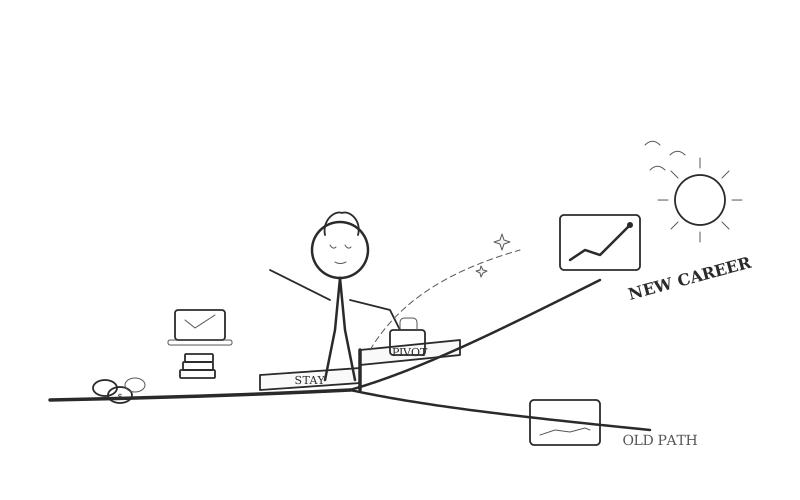
Build the runway before you announce anything. Divide your accessible savings by your essential monthly spending; that number, in months, decides whether you can make a clean break or need a phased transition. Then work four decisions in order: phased or clean break, what retraining is actually worth paying for, how you bridge income, and health coverage inside the 60-day window.
The numbers and rules that bind
- Nobody measures "career changes." Be suspicious of anyone who says they do. BLS states plainly that it "never has attempted to estimate the number of times people change careers," because no consensus exists on what a career change is (BLS National Longitudinal Surveys FAQ). The widely quoted figure behind most "people change careers five to seven times" claims is 12.7 jobs between ages 18 and 56 in a single birth cohort — jobs, not careers.
- Median job tenure is 3.9 years. The lowest since January 2002. It falls to 2.7 years for workers aged 25 to 34 and rises to 9.6 for those 55 to 64 (BLS Employee Tenure, January 2024 — a biennial release).
- About half of job switchers take a pay cut. Analysis of Census SIPP data found 48 percent of people moving directly job-to-job earned less in the new role, with a median change of +2.6 percent (Federal Reserve Bank of St. Louis). Switchers who do gain currently run ahead of stayers: 5.0 percent against 3.6 percent median wage growth (Atlanta Fed Wage Growth Tracker, August 2026). Both measure changing jobs, not changing fields, so treat them as the optimistic case.
- Budget for the mean, not the median, of a job search. Median unemployment duration is 11.4 weeks, but the mean is 26.3 weeks and 27.0 percent of unemployed people have been looking for 27 weeks or more (BLS Employment Situation, Table A-12, August 2026). The gap between those two numbers is the long tail you are financing.
- Your current employer may pay $5,250 of your retraining, tax-free. The Section 127 educational assistance exclusion is $5,250 for 2026 and begins adjusting for inflation only after 2026. Student loan repayment is now a permanent qualifying use, not a temporary one (Rev. Proc. 2025-32; IRS FS-2026-10). This is the single cheapest money in a career change, and it disappears the day you resign.
- Job-search expenses are not deductible, and will not become deductible. The 2025 reconciliation law did not merely extend the suspension — it terminated miscellaneous itemized deductions outright for tax years beginning after 31 December 2025, keeping only an educator-expense carve-out (Joint Committee on Taxation, General Explanation of P.L. 119-21). The IRS's own job-search page still shows the old sunset date; ignore it.
- Quitting still qualifies you for COBRA. COBRA covers voluntary as well as involuntary departure: 18 months of continuation, at least 60 days to elect, at up to 102 percent of the plan's full cost (DOL, An Employee's Guide to COBRA).
- If you served, the private-school cap is $30,908.34. That is the Post-9/11 GI Bill tuition and fees cap for academic year 2026–27 at private and foreign schools; public schools are covered at net in-state cost with no dollar cap (VA benefit rates).
What to do, and when
The expensive mistakes in a career change are nearly all timing mistakes: money left on the table by resigning a month too early, or a coverage gap created by missing a window. Two rows below are bounded by statute.
What retraining actually costs
Published retraining figures are unusually unreliable, because most of them come from the organisations selling the training. The table below gives only prices that can be checked against the provider or a federal dataset, and says so where no verified outcome data exists.
The four decisions
1. Phased or clean break
A phased transition — building the new credential and the first clients while still employed — keeps the income, the coverage and the employer match, and removes the resume gap. It costs time and, usually, a year of evenings. A clean break is faster and is the right call when the new field requires full-time study or clinical hours, or when your current role genuinely cannot coexist with the new one. The honest test is arithmetic, not temperament: if your runway is under six months, the phased route is not a preference, it is the only route that does not force you to accept the first offer that appears.
2. What retraining is worth paying for
Spend on credentials that are a legal or near-legal condition of entry — licences, clinical hours, a bar or CPA qualification. Be far more sceptical about credentials sold as accelerators. As the table above shows, the sector with the loudest outcome claims is also the one with essentially no independently verified outcome data. Before paying, look up the target occupation in the Occupational Outlook Handbook, which is revised annually and states the entry-level education actually required, median pay, and projected growth. If the Handbook says the field's typical entry requirement is a bachelor's degree you already hold, you may be buying reassurance rather than access.
3. How you bridge income
Bridge income is worth more than its hourly rate suggests, because it extends runway at exactly the moment runway is scarcest, and it keeps you from negotiating from fear. The usual sources are consulting in your current field, contract work, and part-time work in the target field — the last being the most valuable, since it pays you while building the record you need. Model it against a full-time search before committing: our freelance bridge versus full-time search comparison sets out when each wins.
4. Health coverage and the 60-day window
Leaving voluntarily does not forfeit COBRA. You get at least 60 days to elect, and COBRA is retroactive to the date coverage ended — so if you are healthy and the marketplace is cheaper, you can apply to the marketplace first and hold the COBRA election in reserve. Losing job-based coverage also opens a 60-day marketplace special enrollment period, and you can report the loss up to 60 days before it happens (HealthCare.gov). Price both against your actual projected income for the year, because the subsidy is calculated on that projection.
If you are going independent
Self-employment changes the tax mechanics more than the tax rate. You owe self-employment tax of 15.3 percent — 12.4 percent Social Security up to the 2026 wage base of $184,500, plus 2.9 percent Medicare with no ceiling — and you pay it quarterly rather than through withholding (IRS; SSA). Half of it is deductible in computing adjusted gross income.
Two things work in your favour. The qualified business income deduction was made permanent by the 2025 reconciliation law, with 2026 thresholds of $201,750 for single filers and $403,500 for joint filers, and a new minimum deduction of $400 for taxpayers with at least $1,000 of qualified business income. And a Solo 401(k) lets you contribute in two capacities: $24,500 as the employee, plus an employer contribution, up to total annual additions of $72,000 for 2026 (IRS Notice 2025-67). The employee deferral limit is shared across every employer plan you participate in during the year, so a mid-year switch does not give you two of them. Our self-employed retirement and tax guide works through the sequencing.
The six expensive mistakes
- Resigning before using the tuition benefit. $5,250 a year of tax-free training is the best-priced money in this whole process and it ends on your last day.
- Financing the transition from the 401(k). A withdrawal before 59½ generally costs income tax plus a 10 percent penalty, and it removes the balance from decades of compounding at the exact moment your contributions also stop.
- Budgeting for the median job search. The median is 11.4 weeks and the mean is 26.3. Plan for the mean.
- Paying for a credential the field does not require. Check the Occupational Outlook Handbook's stated entry requirement before, not after.
- Treating the first offer in the new field as a starting point that can be fixed later. It sets the base every subsequent raise is calculated from, and in a new field you have no internal comparators arguing for you.
- Assuming job-search costs are deductible. They are not, for 2026 or after — and several government pages still say otherwise.
Career change tools
Career pivot salary comparison
Model total compensation in the target field against what you earn now, including the benefits that salary comparisons usually omit. The same tool carries the retirement side: what the contribution gap costs over time, and how quickly a restart closes it.
Freelance income projector
Project bridge income at a given rate and utilisation, net of self-employment tax.
Career change decision engine
Work through the phased-versus-clean-break decision against your own runway and obligations.
Identity transition logistics
The administrative sequence when a career change comes with a name change: the earnings-record correction limit, the free passport window, and the employment verification mismatch that can cost the new job before it starts.
Common questions
How much runway do I need before changing careers?
There is no researched answer, and anyone quoting one precisely is guessing. The arithmetic that does hold: divide accessible savings by essential monthly spending. Under six months and a clean break forces you to accept the first offer; the phased route protects you. Above twelve months you have room for a field that requires full-time study. Between the two, bridge income is what decides it.
Will I take a pay cut?
Possibly, and the honest data is about job changes rather than field changes: 48 percent of direct job-to-job switchers earned less in the new role, with a median change of +2.6 percent. Changing field as well as employer is the harder case, so treat those figures as the optimistic end.
Can I deduct what I spend retraining?
Generally not as an individual. Miscellaneous itemized deductions, which is where unreimbursed work expenses and job-search costs sat, were terminated for tax years beginning after 2025. Employer-provided assistance under Section 127 and, if you are genuinely self-employed, ordinary and necessary business expenses are different routes and still work.
How many careers does the average person have?
Unknown, and not for want of asking. BLS has never attempted the estimate because there is no agreed definition of a career change. The "five to seven careers" line in circulation is a corruption of a jobs statistic from a single birth cohort.
Go deeper
- The financial guide to career change — the long-form version of this page, with worked examples.
- Freelance bridge or full-time search?
- Self-employed retirement and tax strategy
- 2026 retirement contribution limits
- If the change was not your choice
- Student loan default in 2026 — what a deliberate pay cut does to a loan that was already close to the line, and the rehabilitation route back.
Sources
- Bureau of Labor Statistics, National Longitudinal Surveys: questions and answers — on why no career-change estimate exists.
- Bureau of Labor Statistics, Employee Tenure, January 2024.
- Bureau of Labor Statistics, Employment Situation, Table A-12: duration of unemployment, August 2026.
- Bureau of Labor Statistics, Occupational Outlook Handbook.
- Federal Reserve Bank of St. Louis, Half of job switchers earn less in new roles.
- Federal Reserve Bank of Atlanta, Wage Growth Tracker, August 2026.
- Internal Revenue Service, Rev. Proc. 2025-32 — Section 127 exclusion for 2026.
- Internal Revenue Service, FS-2026-10, educational assistance programs.
- Internal Revenue Service, Notice 2025-67 — 2026 retirement plan limits.
- Internal Revenue Service, Estimated tax due dates.
- Joint Committee on Taxation, General Explanation of Public Law 119-21 — termination of miscellaneous itemized deductions.
- Social Security Administration, Contribution and benefit base, 2026.
- U.S. Department of Labor, An Employee's Guide to Health Benefits Under COBRA.
- U.S. Department of Labor, American Job Centers.
- HealthCare.gov, Special enrollment periods.
- National Center for Education Statistics, Digest of Education Statistics, Table 330.50.
- Council on Integrity in Results Reporting, Outcomes data.
- U.S. Department of Veterans Affairs, Post-9/11 GI Bill rates, academic year 2026–27.
Share this
How to Change Careers Without Wrecking Your Finances: everything in one place
3 pages cover this. The one you are reading is marked, so you can see what the others do differently.
Start here
- How to Change Careers Without Wrecking Your Finances you are here