Short answer
The federal adoption credit is $17,670 per child for 2026, and since tax year 2025 up to $5,120 of it is refundable — paid to you even if you owe no tax (Revenue Procedure 2025-32, IRS). If you adopt a child a state or tribal government has determined has special needs, you claim the full credit whether or not you spent anything. Employer help is worth more than most guides say: employers in the Dave Thomas Foundation’s 2026 survey reimburse an average of $16,716. And the cost figures you will find everywhere, including federal ones, are older than they look.
1. The adoption tax credit, and the half of it that is now refundable
For 2026 the credit is $17,670 per eligible child, phasing out between modified adjusted gross income of $265,080 and $305,080 (Revenue Procedure 2025-32, IRS).
The change worth knowing about is refundability. Beginning in tax year 2025, up to $5,120 of the credit is refundable — that portion is paid to you even if your tax liability is zero (IRS). That reverses the position for lower-income adoptive families, who previously got nothing from a credit they could not use. Guidance still describing the credit as entirely non-refundable is out of date.
Two mechanics matter. The non-refundable remainder carries forward for up to five years, so a family with modest annual liability still uses the whole credit eventually. But a carried-forward amount can never later become refundable — once it is in the carryforward it only ever offsets tax (IRS).
| Tax year | Maximum credit | Refundable portion |
|---|---|---|
| 2026 | $17,670 | $5,120 |
| 2025 | $17,280 | first year refundable |
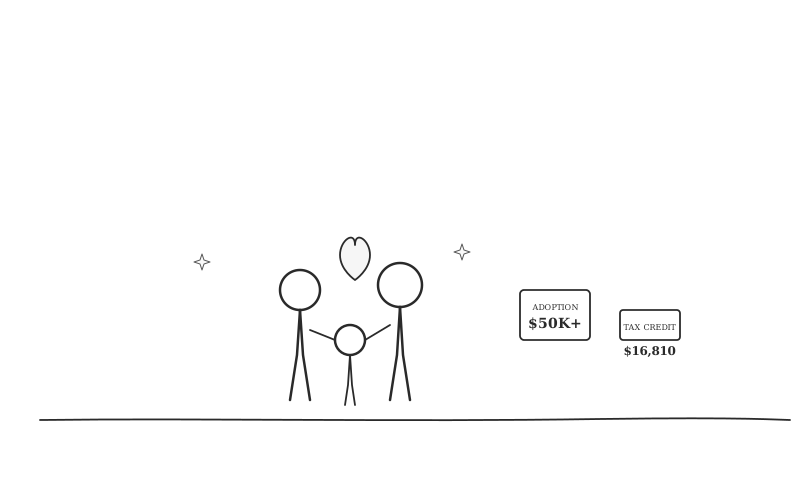
| 2024 | $16,810 | none |
The older rows are here because $16,810 still circulates as a current figure, including in arithmetic for two children, where it understates the credit by $1,720 per child.
What counts as a qualified adoption expense: adoption fees, attorney fees, court costs, and travel including meals and lodging, plus re-adoption costs for a foreign adoption. What does not: adopting your spouse’s child, which is excluded outright (Instructions for Form 8839).
The special-needs rule is the most valuable provision here and the least known. Where a state, the District of Columbia or an Indian tribal government has determined that a child has special needs, you enter the maximum credit even if your qualified expenses were less — and even if you had none at all. Tribal-government parity was added by the One Big Beautiful Bill Act. For a family adopting from foster care, where costs are often near zero, this is the difference between a small credit and the full $17,670.
2. What adoption costs, and how old even the federal figure is
This section comes with a caveat the cost pages never give. The Children’s Bureau does publish adoption costs, in Planning for Adoption: Knowing the Costs and Resources — but that factsheet is dated June 2022, it is no longer readily findable on childwelfare.gov, and it has to be retrieved from the federal document archive (Children’s Bureau, via GovInfo). Four-year-old figures are what the federal government offers here; everything more recent traces to agencies, lenders and aggregators with an interest in the number.
| Route, per the Children’s Bureau (June 2022) | Published range |
|---|---|
| Foster care adoption | “virtually free of cost” |
| Licensed private agency, domestic | $30,000–$60,000 |
| Independent or attorney-assisted, domestic | $25,000–$45,000 |
| Intercountry | $20,000–$50,000 |
| Home study | $1,000–$3,000 |
| Court documentation | $500–$2,000 |
Note what this does to the usual framing. Private agency domestic adoption is the most expensive route in the federal figures, not the middle one, and intercountry adoption is not the most expensive. An earlier version of this page had those two swapped, quoting the intercountry range as the domestic one and giving an international figure that appears in no primary source at all.
Treat the table as a starting shape rather than a quote. Ask any agency for its own written fee schedule and what is not in it — birth-parent expenses where your state permits them, home study updates if the process runs past the study’s validity, post-placement supervision, and for intercountry adoption the document authentication, translation and immigration medical examination that arrive late and together.
3. Foster care adoption, and the number nobody publishes
Adoption from foster care is the route the federal government actually subsidises, in three distinct ways.
Title IV-E adoption assistance is an ongoing monthly payment — and its amount is negotiated between the adoptive parents and the state agency, subject to one ceiling: it may not exceed the foster care maintenance payment that would have been paid had the child remained in foster care (Social Security Act §473, Children’s Bureau). Because it is negotiated and state-set, no federal source publishes a national average or range. Monthly figures quoted as typical — and this page carried a pair of them — are not federal numbers and cannot be relied on for your state. The point that is transferable: the amount is negotiable, so treat the first offer as an opening position and ask what the foster care maintenance rate for your child would have been.
Non-recurring adoption expenses are reimbursed separately: federal matching at 50% for agency expenditure up to $2,000 per adoptive placement, covering one-off costs such as court and attorney fees (45 CFR 1356.41). States may set a lower maximum. This is the provision most families adopting from foster care do not know to ask about.
And the special-needs credit rule above. A child determined to have special needs brings the full $17,670 credit regardless of what you spent, and most children adopted from foster care carry that determination. Combined with a credit that is now partly refundable, the tax position of a foster adoption is far better than the near-zero cost suggests.
4. Employer benefits, which are worth about three times the usual quote
The Dave Thomas Foundation for Adoption surveys employers annually. Its 2026 findings: participating employers offer an average of $16,716 in financial reimbursement for adoption costs, up 6% on 2025, and an average of 8.9 weeks of paid leave for employees who adopt (Dave Thomas Foundation).
Two cautions about how that number is often reported. The Foundation’s certification threshold is at least $5,000 of reimbursement and six weeks of paid leave (Dave Thomas Foundation), which is where a much lower “average” in circulation appears to come from — it is the floor for recognition, not a typical benefit. And the survey is of self-selecting participants, employers who enter to be ranked, so it cannot support claims about what share of large companies offer adoption benefits. Percentages of the Fortune 100 attributed to the Foundation are not figures it publishes.
On the tax side, employer adoption assistance is excluded from your income under section 137 up to $17,670 for 2026, with the same phase-out as the credit (Revenue Procedure 2025-32). The exclusion is not refundable — it reduces taxable income rather than paying you. And you cannot claim both the credit and the exclusion for the same expenses, though you may use both in the same year against different ones (IRS). Ask your employer for the plan document before you spend, because which expenses run through the employer plan determines which remain available for the credit.
5. Adding the child, and the window that is longer than you think
Adoption or placement for adoption is a qualifying event. For a Marketplace plan you have 60 days from the event, and coverage for a dependent gained by adoption or foster placement is retroactive to the date of the event — you may alternatively ask for the first of the month after you choose a plan (CMS). Employer group plans run their own special enrolment period, which is typically shorter, so read the plan documents rather than assuming the Marketplace window applies.
No plan may impose a pre-existing condition exclusion, and that protection has applied specifically to children since plan years beginning on or after 23 September 2010 (HealthCare.gov). A child placed with a known medical condition cannot be refused cover or charged more for it.
6. Leave for adoptive parents
FMLA covers placement for adoption or foster care on the same footing as birth: up to 12 workweeks, unpaid, with the entitlement ending 12 months after the placement (US Department of Labor). Eligibility is narrower than people expect on all four counts: the employer must have 50 or more employees for 20 or more workweeks, you must have worked there 12 months (not necessarily consecutive), logged at least 1,250 hours in the preceding year, and work at a site with at least 50 employees within 75 miles.
There is no federal paid leave for adoptive parents in the private sector (DOL). Paid leave comes from your employer, from a state paid-family-leave programme where one exists, or not at all — which is why the Dave Thomas survey’s 8.9-week average paid-leave figure is worth checking your own employer against.
7. Paying for it across the timeline
Adoption costs do not arrive as one bill. They land in stages across one to three years — application, home study, agency instalments, legal work, travel, finalisation — which makes a total that looks impossible manageable if the saving starts before the process does.
Work the sequence backwards. Establish what your employer reimburses and when it pays, since some plans reimburse only on finalisation and others at placement. Establish whether the child is likely to carry a special-needs determination, because that changes the credit from a reimbursement of expenses into a flat amount. Then set the monthly saving against what is left after those two, not against the gross cost. The figure that matters is the net, and for foster adoption it is frequently negative once the credit and the non-recurring reimbursement are counted.
On borrowing: adoption-specific loans exist and are generally cheaper than credit cards, but no agency publishes a rate comparison and the spread quoted in most guides is not sourced. Get a written rate from the lender and compare it against what you would actually pay on the alternative, rather than against a range.
8. The mistakes that cost the most
Assuming the credit is useless because your tax bill is small. Up to $5,120 is refundable for 2026 and is paid whether or not you owe tax.
Not asking whether the child has a special-needs determination. It converts the credit into the full $17,670 regardless of what you spent.
Not claiming non-recurring adoption expenses. Up to $2,000 per placement is reimbursable for foster adoptions, and it goes unclaimed because nobody mentions it.
Treating the adoption subsidy as a fixed schedule. It is negotiated with the state and capped by the foster care maintenance rate, so ask what that rate would have been.
Running the same expenses through both the employer plan and the credit. You may use both in a year, but not on the same expense.
Quoting a 2024 credit amount. $16,810 is two years old and understates a two-child adoption by $3,440.
Assuming a 30-day insurance window. The Marketplace gives 60 days and back-dates coverage to placement; your employer plan may differ, so check it rather than either default.
Budgeting from cost figures presented as current. The federal ones are from 2022, and everything fresher comes from someone selling the service.
9. Go deeper: the decision behind each section
Each decision above has a page of its own. Start with the adoption decision engine to sequence the credit, employer benefits and saving against your own timeline. The first-year guide for new parents covers what follows placement, the emergency-fund guide covers the reserve that absorbs a staged cost, and the 529 guide covers the education saving that starts once the adoption is finalised. The decision tools run the numbers for your own case.
10. Common questions
How much is the adoption tax credit in 2026? $17,670 per eligible child, phasing out between $265,080 and $305,080 of modified AGI.
Can I get money back if I owe no tax? Yes, up to $5,120 for 2026. The rest carries forward five years but can never become refundable.
Do I need receipts if I adopt a child with special needs? No. Where a state, DC or a tribal government has made that determination you claim the full credit even with no qualified expenses.
Can I claim the credit for adopting my spouse’s child? No. Those expenses are excluded.
What will the monthly adoption subsidy be? There is no national figure. It is negotiated with your state and cannot exceed the foster care maintenance payment the child would have received.
How long do I have to add the child to insurance? 60 days for a Marketplace plan, with coverage retroactive to placement. Employer plans set their own, usually shorter, window.
Is adoption leave paid? FMLA gives 12 unpaid workweeks if you qualify. There is no federal paid leave; employers in the Dave Thomas survey averaged 8.9 weeks of paid leave, which is a benchmark to hold yours against rather than an entitlement.
Sources
Every figure links to the body that publishes it, with the year it applies to. Where no federal figure exists — the monthly adoption subsidy, the share of large employers offering adoption benefits, adoption loan rates — this page says so rather than supplying one. The cost table is the most recent federal publication and is dated June 2022; it is presented with that date attached because nothing more current is published by any agency.
- Tax: Revenue Procedure 2025-32 · IRS 2026 inflation adjustments · IRS adoption credit · notable changes to the adoption credit · Instructions for Form 8839 · 2024 instructions, for the older figure
- Foster care and subsidies: Social Security Act §473 · 45 CFR 1356.41 · Children’s Bureau on adoption assistance
- Costs: Children’s Bureau, Planning for Adoption, June 2022
- Employer benefits: Dave Thomas Foundation, 2026 survey · adoption-friendly workplace criteria
- Leave and insurance: DOL, leave for placement of a child · DOL FMLA FAQ · CMS special enrolment periods · HealthCare.gov, pre-existing conditions